

On September 3, 2026, the International Monetary Fund and the authorities of El Salvador announced a staff-level agreement on the second and third reviews of the country’s program. The part that made headlines was the origin of El Salvador’s bitcoins, which we cover separately: the two official versions of the press release and the documentary gap over that accumulation.
But that same paragraph contains another sentence that received far less attention and is especially relevant for the Dominican Republic: the parties agreed on measures to modernize the legal, regulatory and supervisory framework for digital assets. That is the point worth examining from here.
Why that sentence matters in Santo Domingo
Over the past five years, much of the regional attention on El Salvador focused on its adoption of Bitcoin. That was never the central point of the Dominican case: the Dominican Republic did not adopt Bitcoin, did not declare it legal tender and did not accumulate public holdings as part of a state policy.
The question that is Dominican is the other one: how digital assets are legally organized once they already circulate, are already taxed and already appear by name in rules in force. And that is exactly the question El Salvador has just put in writing in a program with conditionality.
The agreement introduces a new regulatory agenda
The understandings reached on digital assets, which we detailed when the agreement was announced, run along two tracks. One is sectoral: modernizing the legal, regulatory and supervisory framework. The other is internal to the state: strengthening the governance and risk-management mechanisms applicable to the public sector’s crypto-asset holdings. The press release also records a change in the Chivo wallet: majority ownership and operational control were transferred to a private operator, while the government retained a minority stake and custodial responsibility over client assets.
The document does not spell out which rules would be reformed, which authority would supervise or on what timeline. Nor should it be read as a value judgment: the IMF does not say the previous model was good or bad. And it is worth not attributing causal relationships it does not establish: the release describes commitments and a sequence; it does not state that the earlier adoption caused these measures.
Where does the Dominican Republic stand?
Documented fact. This entire section is limited to what the linked official documents say, with the article and subparagraph indicated.
Precision matters here, because in this field imprecision spreads fast. The Dominican framework has four distinct layers, and mixing them produces false statements in both directions.
1. What is restricted: two figures within the payment system
The Central Bank’s communiqué of September 30, 2021, which reiterates the one of June 27, 2017, is explicit about its scope: the BCRD “does not regulate, supervise or in any way guarantee these assets as a means of payment through the Payment System,” and consequently “the regulated institutions of the national financial system are not authorized to use them or carry out operations with them within the Payment System of the Dominican Republic.” It is a communiqué, not a statute: it did not go through Congress, and its force derives from the provisions it invokes, among them Articles 228 to 230 of the Constitution and Articles 24, 28 and 29 of the Monetary and Financial Law 183-02.
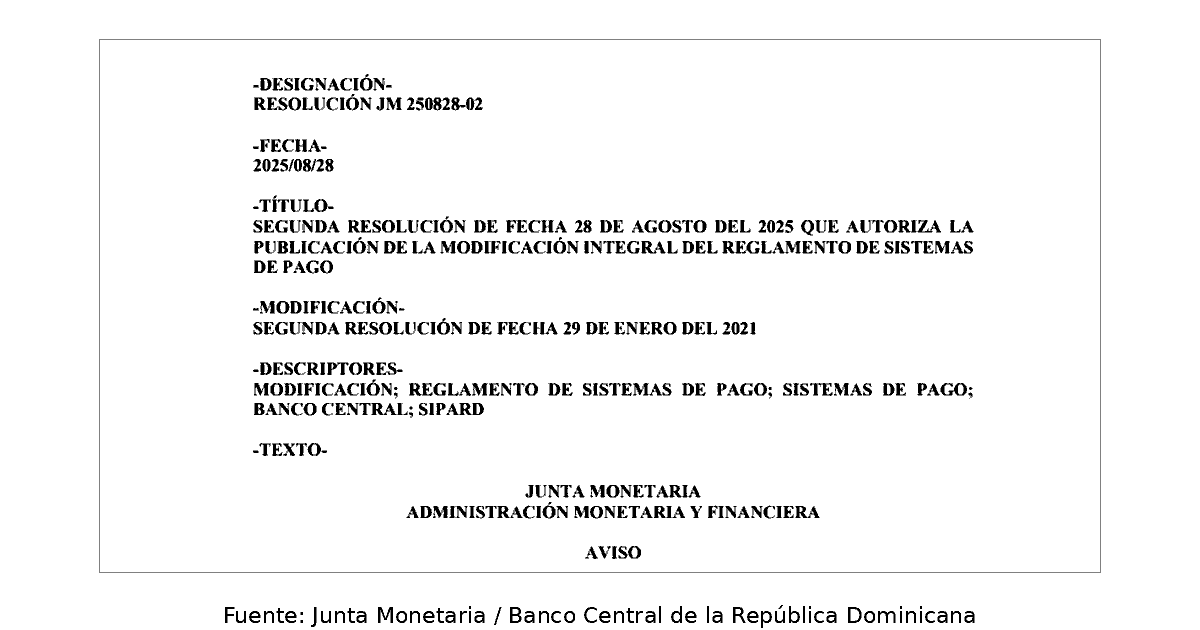
Four years later the matter moved into regulatory text. The Second Resolution of the Monetary Board of August 28, 2025 (JM 250828-02) authorized publication of the comprehensive amendment of the Payment Systems Regulation. That regulation defines, in its Article 4, subparagraph a):
“Virtual asset: Digital representation of value that can be traded or transferred digitally and used for payment or investment purposes, without legal tender in the national territory, foreign currencies or any other asset being understood in any case as a virtual asset.”
Payment Systems Regulation, Article 4, subparagraph a) (our translation)
The definition is open at its core and closed at its edges: it broadly describes what a virtual asset can be and then expressly excludes legal tender, foreign currencies and, with a striking formula, “any other asset.”
The restriction on virtual assets appears in two articles, drafted with the same formula:
- Article 11, subparagraph v). The heading reads: “Obligations of the administrator. The administrator of a payment or securities settlement system shall be obliged to: […] v) Not offer products or services based on virtual assets.”
- Article 17, subparagraph w). The heading reads: “Obligations of the electronic payment entity. The electronic payment entity shall be obliged to: […] w) Not offer products or services based on virtual assets.”
The scope of those two provisions can be read in their own headings. The prohibitions in Articles 11(v) and 17(w) are addressed, respectively, to administrators of payment or securities settlement systems and to electronic payment entities. Those provisions do not establish a general prohibition on holding or using Bitcoin. What cannot be inferred from them is a judgment about the entire legal order: the regulation also has its own scope of application, which under its Article 3 extends “to payment or securities settlement systems, their administrators and participants, as well as other payment service providers and the support entities that offer them services,” and other matters — tax, criminal, anti-money-laundering, corporate — are governed by different rules.
2. What is already taxed, and under which regime
Here there are two distinct precedents that should not be merged into one.
The first is administrative. In ruling G. L. No. 2759, of December 23, 2021, the Dominican tax authority (DGII) answered the case of a software developer resident in the country who provided services to a foreign company in the crypto sector. Its criterion, based on Articles 267, 268 and 297 of the Tax Code, was that “in the event that the said company converts those assets into liquid form (money valid and recognized in the country), including exchanges with third parties, whether or not linked to the financial sector or market, the income generated constitutes taxable income.” In other words: taxable income from an increase in net worth, with the taxable event tied to conversion or exchange.
The second is legislative and later. Law 30-26, enacted on June 18, 2026, amended in its Article 19 subparagraph e) of Article 289 of the Tax Code, which now defines a capital asset as “any property, including digital goods and crypto-assets, held by the taxpayer.” With that, crypto-assets are placed within the legal regime of capital gains and losses.
They are not the same thing. An administrative criterion on taxable income and a statutory definition of a capital asset belong to different tax categories, and the determination of the base and the moment the obligation arises depend on them. That both treatments coincide in taxing does not make them equivalent.
Two further clarifications. The flat 10% rate created by the same Law 30-26, in the new Article 296-1, applies to capital gains from the disposal of real estate by individuals, with a paragraph extending the regime to legal entities whose sole activity is non-commercial real-estate holding: it does not reach crypto-assets. And Article 19 is the only mention of digital goods or crypto-assets in the entire law: there are no valuation rules, no rules for substantiating acquisition cost and no specific reporting obligations. The breakdown of what is declared today, and on what basis, is in our guide to cryptocurrency taxes in the Dominican Republic.
3. What the Criminal Code says
Law No. 74-25, the organic law establishing the Criminal Code, contains in its Article 240 the definition of pyramid fraud, and that is where digital assets appear by name:
“Pyramid fraud is understood as fraud disguised as an apparent business scheme that turns out to be fraudulent, by means of which its perpetrator or perpetrators aim to recruit persons from whom they obtain money, digital assets such as: cryptocurrencies, tokens, NFTs or digital documents with financial value, making them false promises of returns on their investments […].”
Law No. 74-25, Article 240 (our translation)
Articles 241 and 242 complete the offense: the first aggravates the penalty when circumstances such as the use of digital platforms or media and social networks, particularly vulnerable victims, or amounts equal to or greater than one hundred public-sector minimum wages are present; the second criminalizes the complicity of those who act as intermediaries, promoters or brokers.
This does not regulate the sector. Article 240 lists the material objects of a fraud offense; it does not define asset categories for the legal order, does not create licenses, does not assign a supervisor and does not establish rights or obligations for those who use these assets legitimately.
4. What the provisions examined show — and what they do not
The precise formulation is this: the Dominican Republic already has provisions that reach certain aspects of digital assets, but not a specific, comprehensive sectoral law. It should be made clear that “comprehensive sectoral law” is our own editorial description of the degree of regulatory consolidation, not the name of a legal category in the Dominican system. What can be stated within the scope of this research is narrower: the documents examined for this article do not establish a comprehensive sectoral licensing and supervision regime specific to exchanges and custodians, nor an equivalent set of sector-specific consumer-protection rules or reporting obligations. Two bills filed in 2026 were studied by the Standing Committee on Finance of the Chamber of Deputies and remain without a committee report. We have followed that process in our coverage of the scattered rules that already reach crypto-assets and in the legislative path between 2023 and 2026.
And on the other side, with the same care: the provisions examined in this article do not establish a general prohibition on holding Bitcoin or on voluntarily accepting it as a means of payment between private parties. None of them addresses those situations. A different matter is the warnings the Central Bank itself does issue: that these assets do not have its backing and are not legal tender, that “no person is under any obligation to accept them as a form of payment,” and that whoever operates with them does so at their own risk and outside the payment mechanisms authorized by the Monetary Board, in the terms of its communiqué.
Turning a restriction addressed to two regulated figures into a supposed general prohibition is a recurring error in coverage of the subject, and it misinforms users about what the rule says and whom it addresses.
The lesson: define before, not after
Editorial analysis by CriptoDominicano and a proposed lesson. No institution cited endorses what follows.
El Salvador is formalizing its supervisory framework in a country where adoption was already in place, where the public sector holds crypto-assets over which the agreement itself provides for strengthened governance, and where the state wallet changed its ownership and control structure. The Dominican Republic has none of those three circumstances on its plate. That, in our view, is its advantage: it can design calmly, before the fact.
Designing before the fact means being able to settle, without pressure, pieces that other jurisdictions had to settle on the fly:
- Legal definitions. What a virtual asset is, what it is not, and which categories deserve different treatment.
- Custody. Who may hold third-party assets, with what guarantees, and what happens in the event of insolvency.
- Service providers. Registration or licensing, minimum requirements, and a clear answer to the question of who supervises.
- Consumer protection. Disclosure, advertising and liability, which today depend on the general regime.
- Anti-money-laundering. Obligations proportionate to the real risk of each activity.
- Taxation. Valuation rules, substantiation of acquisition cost, and the treatment of mining, staking and swaps, which Law 30-26 did not resolve.
- Legal certainty. That a company operating legally can open and keep a bank account.
- Coordination. The relevant powers are distributed among different institutions, including the Central Bank, the Superintendency of Banks, the Securities Market Superintendency and the DGII.
None of this amounts to saying that regulating is always better. A bad law can do more harm than a gap: it can drive out legitimate activity, make services more expensive and increase the difficulty of accessing the financial system. The advantage of arriving late exists only if it is used to arrive better.
Three texts, three vocabularies
The terms that follow are taken literally from each rule. The reading of their consequences is ours.
The Payment Systems Regulation says “virtual asset.” The Tax Code, after Law 30-26, says “digital goods and crypto-assets.” The Criminal Code says “digital assets such as: cryptocurrencies, tokens, NFTs or digital documents with financial value.” Three Dominican rules in force, three families of terms, with no shared definitions among them.
Our reading is that this terminological dispersion matters. An asset with no issuer, no promise of return and no counterparty poses different risks from a token issued by a company that promises returns, and both differ from a stablecoin backed by a third party’s reserves. The challenge for future Dominican legislation will be to distinguish between activities that introduce intermediation, custody or counterparty risk and those where carrying over the same restrictions could prove disproportionate. It is the difference between supervising someone who holds other people’s money and supervising someone who keeps their own keys.
A window that does not stay open forever
The Salvadoran file is neither a model to copy nor a failure to steer away from. It is an available case study, with public documentation and a multilateral body translating these matters into verifiable commitments. It serves to see which questions arise when regulatory formalization arrives with adoption already under way.
The Dominican Republic is in a different position: it already has scattered regulatory pieces and a tax treatment, and it can still define precisely the perimeter, the responsibilities and the safeguards before the ecosystem grows. The opportunity lies in defining that perimeter before the growth of the ecosystem forces these questions to be resolved under greater pressure.
Primary sources
- International Monetary Fund, press release No. 26/285, September 3, 2026.
- Central Bank of the Dominican Republic, communiqué on cryptocurrencies and virtual currencies and assets, September 30, 2021 (in Spanish).
- Monetary Board, Second Resolution JM 250828-02, of August 28, 2025, authorizing the comprehensive amendment of the Payment Systems Regulation (Articles 3, 4 subparagraph a, 11 subparagraph v and 17 subparagraph w) (in Spanish).
- Dirección General de Impuestos Internos (DGII), ruling G. L. No. 2759, of December 23, 2021 (in Spanish).
- National Congress, Law No. 30-26, enacted June 18, 2026 (Articles 14 and 19) (in Spanish).
- National Congress, Law No. 74-25, organic law establishing the Criminal Code of the Dominican Republic, of August 3, 2025 (Articles 240 to 242, pages 123 and 124 of the official text) (in Spanish).
Note on method: this article separates three levels. The sections on the IMF agreement and on the Dominican framework are documented fact and are limited to what the cited official documents say, with article and subparagraph references where applicable. The sections “The lesson” and “Three texts, three vocabularies” contain editorial analysis by CriptoDominicano and proposed readings: they do not reflect the positions of the IMF, the Monetary Board, the Central Bank, the DGII or any other institution, and their citation in this text implies no endorsement of our analysis. Quotations from Dominican legal texts are our own translations from the Spanish originals; this is an English adaptation of our Spanish-language article published on September 5, 2026.


