

The International Monetary Fund’s press release of September 3, 2026 attributes the Bitcoin accumulation recorded by El Salvador since the first review of its program to private donations. The English version states explicitly that documentation was provided to the Fund. The Spanish version does not include that detail in that sentence.
The difference is not cosmetic. The program in force since February 2025 maintains a continuous performance criterion that sets voluntary Bitcoin accumulation by the Salvadoran public sector at zero, and defines the perimeter of that sector by expressly including the National Bitcoin Office. What the Fund says about the basis for its statement — and what cannot be verified from the outside — determines what can be asserted today about the origin of those bitcoins.
The regulatory content of the same agreement, covering the modernization of the legal and supervisory framework for digital assets, we covered on September 4. This analysis deals with something else: what backs up the explanation.
Two wordings for the same statement
The staff-level agreement on the combined second and third reviews of the Extended Fund Facility would enable a disbursement of close to USD 140 million (SDR 101.96 million), subject to approval by the Executive Board and the completion of prior actions. Within the statement by the mission chief for El Salvador, Torres, appears the sentence that shaped the week’s international coverage.
The English version reads: “Documentation has been provided verifying that Bitcoin accumulation since the first review reflects private donations and that no public resources were used.”
The Spanish version reads: “La acumulación de Bitcoin desde la primera revisión refleja donaciones privadas y no ha implicado el uso de recursos públicos” — that is, “Bitcoin accumulation since the first review reflects private donations and has not involved the use of public resources” (our translation).
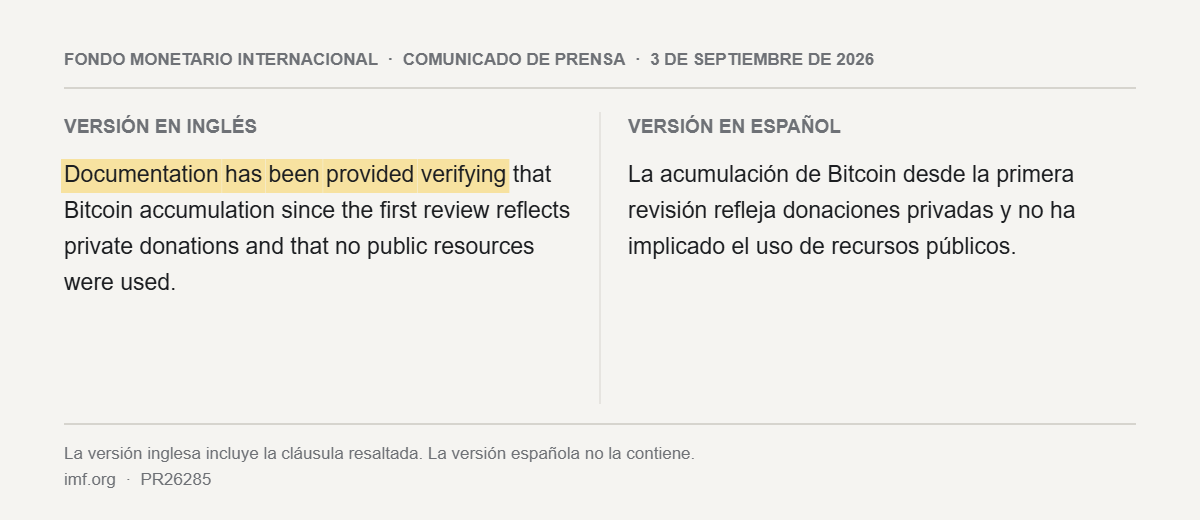
It is the same statement on the Fund’s official website, in its two publication languages. The English one notes that documentation was provided; it does not identify who provided it, does not describe its content and does not detail any procedure applied to it. The Spanish one states the substance without that clause.
The reading should not be forced. The Spanish version retains a documentary reference one sentence later, when it notes that no additional Bitcoin accumulation is envisaged beyond the documented donations. And the summary heading the release matches in both languages: no public resources have been used for Bitcoin accumulation. The difference is confined to the attribution paragraph.
That changes the information available to the reader about the basis for the claim: the English version makes explicit that documentation was provided to the Fund; the Spanish one does not include that detail in that sentence. For the Spanish-speaking public — and for much of the region’s media, which worked from the Spanish version — the sentence arrives without the only clue the release offers about where it comes from.
What exactly the program prohibits
The founding document of the arrangement, Country Report 25/58 of February 2025, includes among its quantitative performance criteria one of a continuous nature: the non-accumulation of Bitcoins by the government, with the ceiling set at zero.
The Technical Memorandum of Understanding in the same report defines the two terms that make that criterion operational.
The perimeter, in its paragraph 22: public-sector bitcoins are those held in all cold and hot wallets owned or controlled by the public sector, including Chivo, the Bitcoin Fund Management Agency, the National Bitcoin Office and the other public entities, net of Chivo customers’ Bitcoin deposits.
The memorandum expressly includes the National Bitcoin Office within the institutional perimeter. That does not, on its own, establish that the public wallet labeled ONBTC is equivalent to the public-sector Bitcoin aggregate used to measure the criterion: the aggregate covers all wallets of all entities in the perimeter and is calculated net of Chivo customer deposits, and that calculation is not published.
The prohibited conduct, in paragraph 23: voluntary accumulation of bitcoins includes the purchase and mining of Bitcoins and excludes accumulation resulting from forfeiture, seizure, confiscation, custody or any other form of government ownership or possession arising from law-enforcement measures adopted under Salvadoran law.
This is where what the document resolves ends. The word “donation” appears nowhere in Report 25/58: not in the body, not in the memorandum of economic and financial policies, not in the technical memorandum. The list in paragraph 23 is built with “includes,” not “includes only,” and the sole explicit exclusion is the one arising from law-enforcement measures. With the public documents available, it cannot be established whether a donation received by an entity within the perimeter counts as voluntary accumulation for the purposes of the criterion. Nor can the opposite be established. It remains an open question.
Something more can be established: the same memorandum requires the Ministry of Finance to confirm in writing, every month, that the amounts of Bitcoin owned or controlled by the public sector have not changed and that no new wallet has come under its ownership or control. If either of those circumstances occurs, it must be reported. The reporting regime was designed, from the outset, to capture any variation in the aggregate, whatever its cause.
The first review had already stumbled on this criterion
The precedent is in Country Report 25/190, of June 2025. Staff recorded there that, despite compliance with the commitment not to accumulate Bitcoin voluntarily, the continuous performance criterion on voluntary Bitcoin accumulation was missed by small margins due to temporary fluctuations in Chivo customers’ Bitcoin deposits. The authorities requested a waiver and staff supported it, on the grounds that the deviations were minor in nature.
The same report maintains, in two different registers, that aggregate holdings did not change. The authorities state it in their letter of intent and in their policy memorandum; staff records it on its own account in the final assessment, noting that the authorities continue to adhere to the commitment to keep the public sector’s overall Bitcoin holdings unchanged, despite communication difficulties and minor deviations. It is therefore not a claim made exclusively by the Salvadoran government.
The two things coexist without apparent contradiction, and the reason is methodological: the criterion is measured on an aggregate calculated net of Chivo customers’ Bitcoin deposits. A temporary variation in those deposits moves the net measurement without, in itself, implying a change in the public sector’s gross holdings. That is exactly what the report describes.
One additional clarification, because it is often lost: in that review a modification of performance criteria was also requested, but it concerned the liquid-asset ratio of depository institutions, to correct an error in the table. The Bitcoin criterion was not modified.
What the public record shows, and with what limits
The ONBTC wallet on the official Salvadoran explorer can be verified by anyone. We reconstructed its full history from the data published by the state’s own website, and the result reproduces, down to the last satoshi, the balance the page shows: 7,765.37428655 BTC across twenty addresses as of September 5, 2026.
Measuring the increase “since the first review” requires choosing a date, and the release does not define one. There are at least three defensible choices, and each yields a different result:
- since March 31, 2025, the test date for that review’s quantitative criteria: +1,632.19097298 BTC
- since May 27, 2025, the date of the staff-level agreement: +1,576.19072975 BTC
- since June 27, 2025, the date the Executive Board completed the review: +1,544.19025598 BTC
None of the three is “the” correct figure. They are three defensible readings of an expression the Fund left undefined, and the gap between the largest and the smallest exceeds eighty bitcoins.
Taking the scenario that yields the smallest figure — cutoff at June 27, 2025 — the wallet recorded 461 net movements: 455 positive and 6 negative, all of the latter below 0.00081337 BTC and consistent with fees. There are no material outflows. Of the inflows, 433 are of exactly 1.00000000 BTC, in a daily pattern that continues: the latest corresponds to September 5, 2026. The largest single inflow of the period is 1,090.19067986 BTC, on November 18, 2025.
What the blockchain allows us to assert is limited. It allows us to assert that those addresses received those amounts on those dates. It does not allow us to assert, on its own, that they were purchased, donated, acquired with public resources or received by the government. And it does not allow us to assert that the variation in this wallet equals the variation in the aggregate the program measures.
That last point is what prevents closing the circle. Between February 26, 2025, the date the Extended Fund Facility was approved, and June 27, 2025, the ONBTC wallet went from 6,090.18315128 to 6,221.18403057 BTC: 131.00087929 BTC more. Over that same period, both the authorities and staff described the public sector’s aggregate holdings as unchanged. The two observations refer to different magnitudes — an observable public wallet, and an aggregate that is not published and is measured in net terms — and with public information it is not possible to reconcile them, nor to rule out that they are compatible.
Methodology
Balances were reconstructed by adding the net effect of each transaction across the wallet’s twenty addresses, ordered by confirmation date, from the data exposed by the official explorer. The cumulative total exactly reproduces the confirmed balance shown on the page, which validates the series. Query performed on September 5, 2026 at 22:36 UTC. All dates and cutoffs are expressed in UTC; the explorer displays times in the visitor’s time zone.
What remains outside public reach
The September 3 agreement is preliminary. It reflects staff conclusions, which the release itself notes do not necessarily represent those of the Executive Board, and it is subject to that Board’s approval and to the completion of prior actions. The report for this review, which is where the definitions, the criteria tables and the detail of what was examined usually appear, has not yet been published.
Until it is published, there are three things that cannot be established from the outside: what that documentation is, what it contains and who provided it. And a fourth, which the release itself leaves open: the Fund notes that efforts continue to improve the transparency of Bitcoin holdings across the various wallets, when the delivery of a signed statement with the addresses of all public-sector wallets was among the structural commitments met in the first quarter of 2025.
The Fund attributes. The blockchain records. Between the one and the other there is a stretch that today can only be traveled with documents that are not public.
Note on sources and translation: this is an English adaptation of our Spanish-language analysis published on September 5, 2026. The IMF press release is quoted from its official English and Spanish versions. Passages from Country Reports 25/58 and 25/190, which the IMF publishes in English, are rendered here in our own words from those documents rather than as verbatim quotations; readers should consult the linked reports for the exact wording.


